
MiCHEP Humanities Grants Create Space for Learning, Creativity and Exploration

What can happen when students have more opportunities to explore the humanities alongside their college education?
Across Michigan, MiCHEP member institutions are exploring that question through a new Humanities Grant Initiative, which provides funding for humanities-based courses, workshops, creative projects and other opportunities within prison education programs.
The program was created to give member institutions space to develop ideas that respond to the interests and needs of their students and programs. Rather than prescribing a single approach to humanities education, the grants support a range of projects that create opportunities for students to write, make music, study ethics, engage with poetry and explore new areas of learning.

For Dini Metro-Roland, MiCHEP's Humanities Grant Initiative Program Director and a Professor of Educational Foundations at Western Michigan University, access to the humanities is a critical part of a complete college education. Humanities education gives students opportunities to reflect on their experiences, encounter different perspectives and consider questions that extend beyond the immediate demands of a particular field of study.
This year's grants are supporting five projects across Hope College, Grand Valley State University, and Lake Superior State University.
Five Projects, Five Approaches

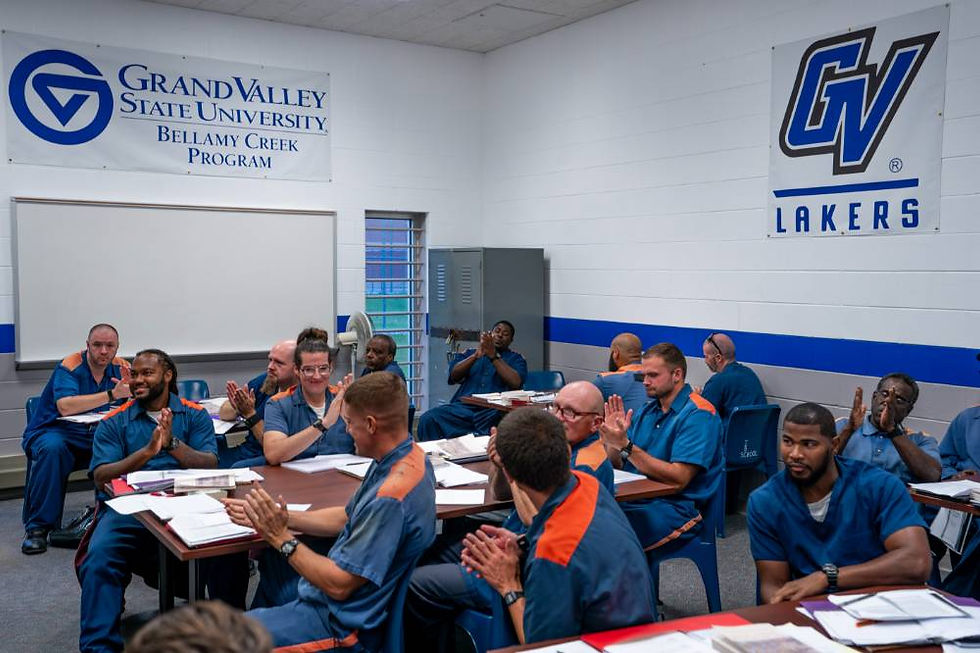
At Grand Valley State University (GVSU), a new three-part creative writing workshop series will invite people incarcerated at Bellamy Creek Correctional Facility, including those who are not currently enrolled in GVSU's prison education program, to explore creative nonfiction, fiction and poetry. Participants will develop their writing throughout the workshops, with opportunities to revise work for publication and a culminating showcase event.
A second GVSU project builds on an ethics course taught during Winter 2026. The eight-part Wholeness Ethics Workshop Series will explore how ideas from the course can be applied more directly to students' environment in prison. The pilot will be developed collaboratively by humanities faculty, students and an expert facilitator with lived experience in prison education.

At Lake Superior State University (LSSU), a student music club within the STEP UP program is expanding into a year-long humanities initiative. In addition to developing musical skills, students will explore music's cultural, historical and social contexts through ukulele instruction, books, lectures and workshops.
LSSU is also developing a statewide poetry anthology featuring original work from incarcerated students at MiCHEP member institutions. The project will include poetry workshops, a juried cover-art competition, a public book launch and print and electronic distribution. The anthology currently involves three participating institutions, with the goal of expanding to additional MiCHEP members in future years.

Through the Hope-Western Prison Education Program, students will apply humanities skills and knowledge in rhetoric, communication and writing to develop resources for learning in prison. The project will create handbooks and curricula for debate and rhetoric and for a writing center, helping students put humanities concepts into practice while strengthening the program's existing opportunities for learning. The resulting resources will be available to other MiCHEP member institutions as well.
Together, the projects demonstrate the range of approaches institutions can take when they have resources to develop humanities programming. One project extends creative writing opportunities beyond students already enrolled in a college program. Another takes ideas from an existing course into a new setting. A third builds on an established student community around music, while the poetry anthology creates an opportunity for students' work to be shared across institutions and with broader audiences. At Hope, students are applying humanities knowledge to create resources that can support learning within their own program and be shared with other MiCHEP institutions.
Learning Across Institutions
Although the projects differ in subject and format, variety is an important part of the grant initiative.
The goal is not simply to fund individual projects, but to create opportunities for MiCHEP member institutions to learn from one another. Grant recipients will share resources and practices, participate in ongoing conversations about their work and have opportunities to present what they are learning through MiCHEP's annual conference and other gatherings.
For Dini, that cross-institutional exchange is an important part of the initiative. Institutions can see how other programs are approaching humanities education, consider what might work in their own settings and continue developing their ideas beyond the initial grant period.
The program also creates space for experimentation. Some projects may contribute to ongoing programs, while others might lead to the creation of new courses, collaborations or approaches to humanities education.
As the projects take shape, MiCHEP will continue learning alongside its member institutions and the students, faculty and program staff who bring them to life. By supporting different approaches to humanities education, the Humanities Grant Initiative creates opportunities for institutions to develop programming that is responsive to their students while contributing to a broader conversation about what a complete college education can look like in prison.

Comments